


 CommSec
12 August 2026
Author: James Gruber is Equity Market Strategist at CommSec
In late 2024, the Australian Prudential Regulation Authority (APRA), did the unexpected: announcing its intention to restrict banks from issuing hybrid securities – a $40 billion market with retail investors holding an estimated 20-30% share - and said existing hybrids would be phased out by 2032.
That was a shock to many investors and retirees who had invested in these instruments for both their yield and franking credit benefits. But they knew there was time before any decisions would need to be made about a switch out of hybrids.
Fast forward to today and decision time is fast approaching. That is because the phasing out of hybrid securities will begin early next year.
But that is not the full story because while the phase-out officially starts in 2027, in practice the market started transitioning in 2025 because banks stopped replacing many redeemed hybrids.
In the past, most investors rolled into new five or seven-year hybrid deals when one ended. Now, as hybrids are redeemed, investors are getting their money back and having to deploy it elsewhere. It is a process that will likely accelerate moving forward.
Before explaining some alternatives to bank hybrids, let us look at what these hybrids are and why APRA decided to phase them out.
What are bank hybrids?
Bank hybrids are securities issued by banks that sit somewhere between a bond and a share.
They were created to give banks a source of capital that helps absorb losses in a financial crisis, while providing investors with a higher level of income than traditional bonds.
Think of them as "bond-like investments with equity-like risks."
Under normal conditions, hybrids behave much like floating-rate bonds. Investors receive regular distributions, which are often fully franked and typically 2-2.5% above the bank bill swap rate, and many hybrids have historically been redeemed by the issuing bank on their first call date.
But they are not bonds.
If a bank gets into serious financial trouble, hybrids can be converted into ordinary shares or written off completely. That is because they are designed to protect depositors and senior bondholders - not hybrid investors.
Where do hybrids sit in the capital structure?
When a bank fails, investors are paid in a strict order.
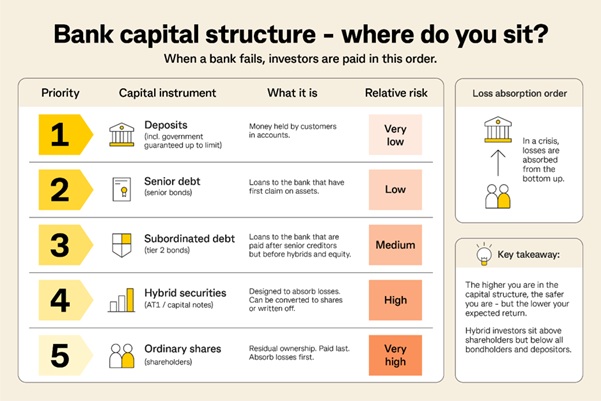
Source: CommSec
The further down you sit, the greater the risk - for example, not being paid out on a default event. However, a higher risk may typically lead to a higher expected return.
Why have investors liked them?
For many Australian investors, hybrids offered an attractive combination of features:
- Higher income than senior bonds.
- Floating-rate distributions that generally rise with interest rates.
- Franking credits on many distributions.
- Exposure to high-quality Australian banks.
That combination made hybrids particularly popular with retirees and income-focused investors.
So why are they disappearing?
The demise of bank hybrids can be traced back to the collapse of Credit Suisse in 2023. When the Swiss bank was rescued, hybrid investors lost around US$17 billion, highlighting the risks of these complex securities, many of which were held by retail investors.
Following a review, APRA announced in December 2024 that Australian banks would phase out Additional Tier One (AT1) hybrids as regulatory capital. Existing hybrids will continue until their call dates, but no new bank hybrids are expected to be issued, with the market set to disappear by 2032.
Alternatives to bank hybrids
With bank hybrids being phased out, investors who have relied on them for income will need to consider alternative investments. While no single product offers the same combination of floating-rate income, franking credits and bank credit exposure, several alternatives could help fill the gap.
1. Subordinated debt
Subordinated debt is the closest replacement for bank hybrids.
Like hybrids, subordinated bonds are issued by banks and sit below senior debt in the capital structure. However, they rank ahead of hybrids, making them less risky. In return, investors generally receive a slightly lower yield, and unlike hybrids, interest payments are not franked.
Subordinated debt is likely to become the preferred way for investors to gain exposure to bank credit as hybrids disappear.
At the time of writing, there are two listed passive subordinated bond ETFs, under the codes, SUBD and BSUB.
2. Senior Debt
Senior bonds rank ahead of subordinated debt and hybrids and are among the safest forms of bank funding.
Because senior bondholders have a higher claim on a bank's assets, expected returns are lower than both hybrids and subordinated debt. Interest payments are contractual and are not franked.
Senior debt may appeal to investors prioritising capital preservation over income.
There are many active funds which hold senior debt. There is also one pure-play senior debt ETF on the ASX, under the code, QPON.
3. Active Fixed Income Funds
Managed bond funds provide diversified exposure across government bonds, bank debt and corporate credit.
Professional managers can actively adjust interest rate exposure, credit quality and duration as market conditions change. Rather than relying on a single issuer, investors gain exposure to hundreds of securities.
These funds may suit investors seeking diversification and professional management without purchasing individual bonds.
4. Private Credit
Private credit has become one of the fastest-growing income sectors in Australia.
Instead of lending through public bond markets, private credit funds lend directly to businesses, property developers and infrastructure projects. In return, investors could receive higher yields than listed bonds.
However, these higher returns come with additional risks, including lower liquidity, less transparency and greater reliance on the manager's credit assessment. Investors should carefully understand the underlying loans before investing.
5. Australian equities
For investors who valued hybrids primarily for their franked income, Australian shares remain one of the few alternatives that continue to provide franking credits.
Dividend-paying companies, particularly banks, insurers and infrastructure businesses, can generate attractive income over the long term. However, unlike hybrids, dividends are not guaranteed and share prices can fluctuate significantly.
Equities are therefore best suited to investors willing to accept greater capital volatility in exchange for higher long-term return potential.
Choosing the right alternative
The best replacement depends on what investors valued most about hybrids.
If the objective was exposure to bank credit, subordinated debt may be the closest substitute. Investors seeking greater security may prefer senior bonds or diversified fixed income funds. Those willing to accept additional risk for higher income may consider private credit, while investors wanting to preserve access to franking credits may consider to increasing their allocation to Australian equities.
Ultimately, there is no perfect replacement for bank hybrids. Instead, many investors are likely to use a combination of these alternatives to balance income, risk and diversification as the hybrid market gradually disappears.
 Back to

