


 CommSec
6 November 2026
Author: James Gruber is Equity Market Strategist at CommSec
October is typically an eventful month for markets, and this one was no different. The US earnings season intensified concerns about returns from enormous investment in artificial intelligence (AI), contributing to the Nasdaq suffering its worst month since March last year. Meanwhile, higher US inflation did not stop Treasury yields posting their biggest monthly decline in nearly three years, while gold fell to a one-year low.
In Australia, the share market's relatively low exposure to technology stocks helped it outperform many developed markets, with the ASX 200 rising during the month. That was despite signs that higher interest rates were weighing on consumer spending and the outlook for some retailers.
Australian share market performance
The ASX 200 rose 1.35% in October, its best month since July. The Big Four banks led the way, with CBA up around 10%, ANZ 7%, NAB 6% and Westpac 5%.
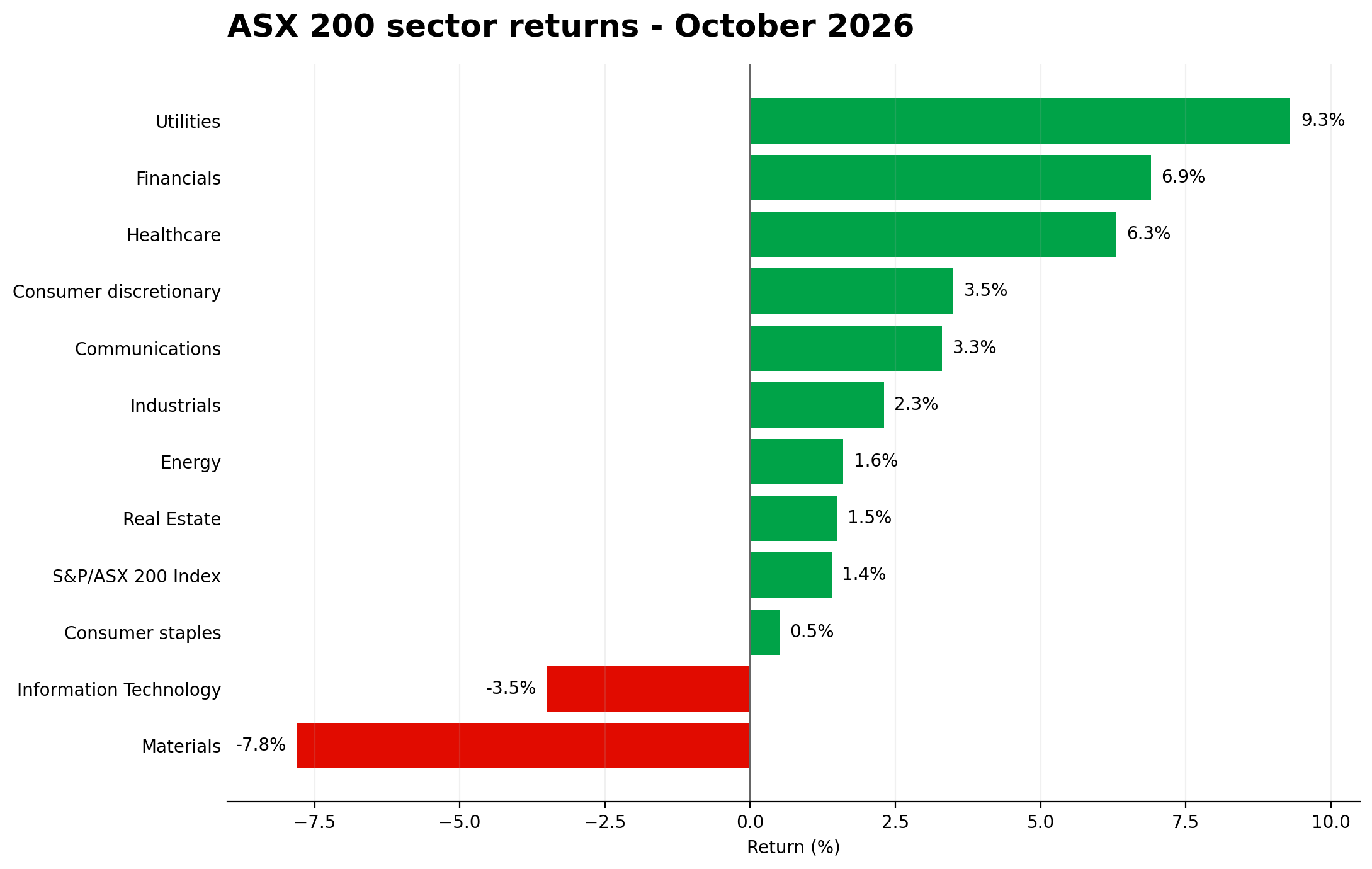
Utilities were the best-performing sector, rising 9.3%, followed by financials at 6.9% and healthcare at 6.3%.
Materials was the major drag on the index, falling 7.8% amid weakness in many commodity prices. Rio Tinto fell 11.8% and BHP 5.4%.
Source: Iress, CommSec
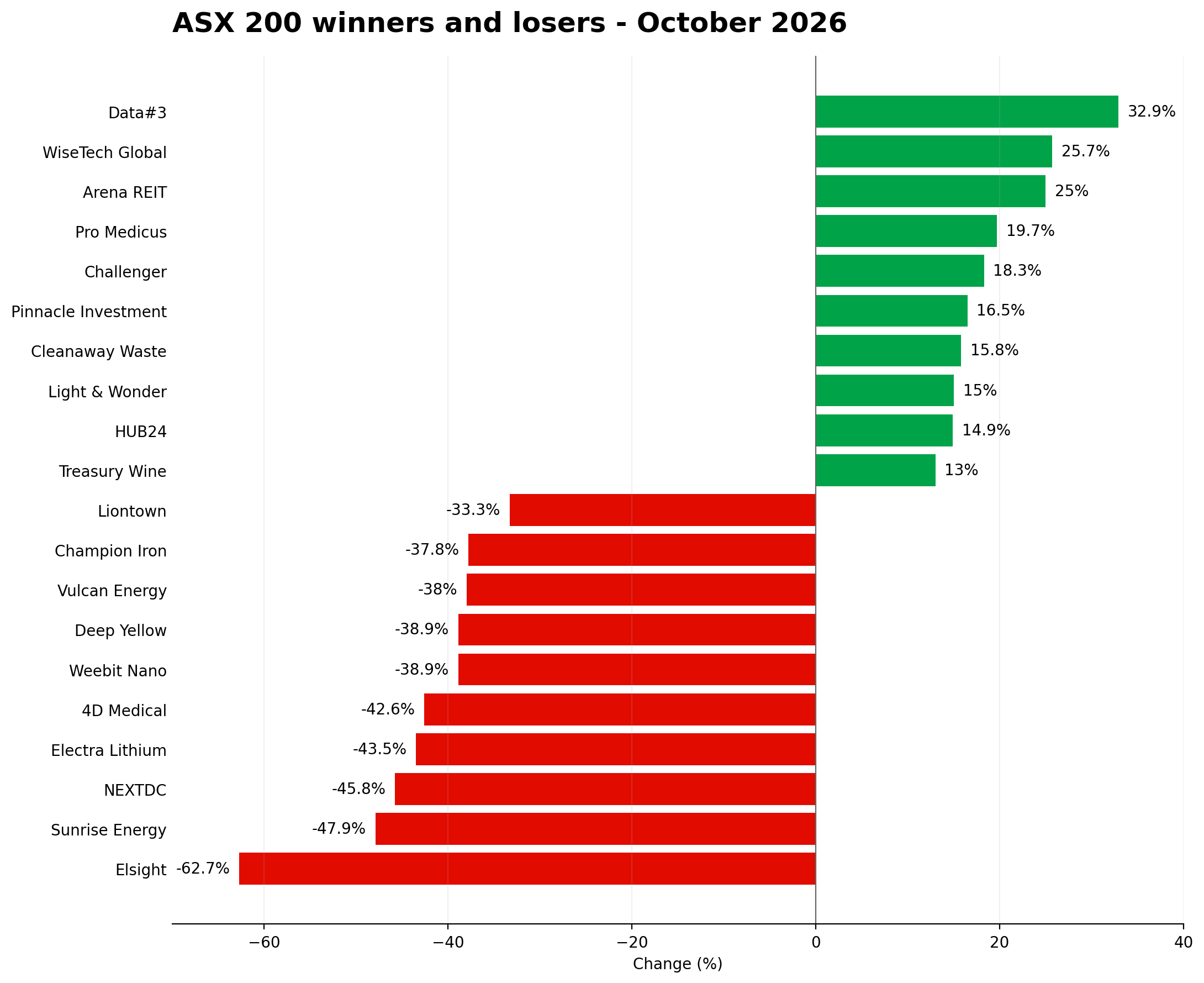
Among individual stocks on the ASX 200, Data#3 surged after upgrading its earnings forecasts. WiseTech also rallied after ASIC concluded investigations concerning the company and several current or former executives without taking enforcement action.
Among the biggest losers in the index, NEXTDC plummeted after downgrading its FY27 earnings guidance, primarily due to delays to electricity infrastructure at its M3 Melbourne data centre.
Source: Iress, CommSec
US share market performance
There was a marked divergence between the three major US indices in October. The Dow rose 1.7%, while the S&P 500 fell 0.9%. However, it was the Nasdaq making headlines, falling 5.3% in its worst month since March 2025.
There was a significant sell-off in AI-related stocks. It started with so-called neoclouds such as CoreWeave amid concerns about the financing of their data centre buildouts. It then spread during earnings season as investors scrutinised the returns being generated by enormous spending on AI infrastructure.
Weakness in parts of Alphabet's search and Amazon's e-commerce businesses added to broader concerns about growth, while investors continued to debate whether AI could disrupt established technology business models.
Intel tumbled 45% during the month, including a 29% fall on the final trading day of October – its worst one-day performance since 1974. The company's third-quarter earnings report raised doubts about the pace of its turnaround and operating performance.
Meanwhile, Alphabet fell 19%, Micron 17%, Meta 15% and Nvidia 10%.
The weakness in technology and AI-related stocks was partially offset by gains in healthcare, consumer staples and oil and gas.
Other world share markets
Europe held up better than many markets, rising 1.9% amid generally positive earnings results.
Asia was weaker, especially in markets with large technology exposure. South Korea's KOSPI slumped 16.2% and Japan's Nikkei 225 fell 5.2%.
Chinese equities were also weaker amid low consumer confidence and continued problems in the property market, with the CSI 300 falling around 8.5%.
Bonds
Global bonds, including Australia's, staged a significant turnaround, with yields falling as some investors responded to a softer growth outlook and attractive valuations.
The US 10-year Treasury yield fell around 36 basis points during October, its biggest monthly decline since December 2023.
One notable exception was France, where government bond yields remained under pressure amid concerns about the country's fiscal outlook and political uncertainty.
Commodities
Brent crude oil futures were the standout commodity in October, gaining around 14%. Escalating tensions in the Middle East, including Houthi attacks and concerns about disruption to regional energy infrastructure and shipping, reinforced supply risks.
Most other major commodities declined.
Copper fell 1.5% amid concerns about the global demand outlook, including questions about the pace of investment in AI-related infrastructure.
Gold fell 6.5% to a one-year low. Persistent US inflation and expectations that US interest rates could remain elevated or rise further weighed on the non-yielding precious metal.
Australian dollar
The US dollar strengthened against many major currencies during October, but the Australian dollar was an exception.
The Aussie climbed around 1.2% against the US dollar, supported by expectations that persistent domestic inflation would prompt further Reserve Bank of Australia interest rate increases.
Key events during the month
• US earnings season ramped up. Results from the megacap technology companies dominated headlines, with investors closely scrutinising the returns being generated by huge amounts of AI spending.
Alphabet slumped after reporting disappointing results from its search business, while Amazon also missed estimates amid softer-than-expected e-commerce earnings. However, Microsoft's sales rose 19% year-on-year and its shares rallied, while Meta's earnings report also initially pleased investors.
• Anthropic filed for an IPO. On October 26, Anthropic publicly filed to list on the Nasdaq under the ticker ANT. It reported revenue of US$16.3 billion in the first half of 2026, more than 12 times the prior-year period.
• The US Federal Reserve kept rates on hold. The Fed left its target range unchanged at 3.75%–4.00%, as expected. It said inflation remained elevated and indicated it wanted more information before determining its next move.
• Middle East tensions pushed oil prices higher. Oil prices jumped following reports of further Houthi attacks in the region, reinforcing concerns about energy supplies and shipping. The escalation offset some optimism surrounding diplomatic efforts to restart negotiations between the US and Iran.
• Australian inflation strengthened the case for another RBA rate rise. Senior RBA representatives made several speeches and presentations during the month, with Governor Michele Bullock indicating that inflation remained too high.
Subsequent data showed quarterly trimmed mean inflation increased by 1.0%, above the RBA's August forecast of 0.8% quarter-on-quarter. Monthly headline inflation rose 0.8% in September, lifting the annual rate from 4.0% to 4.3%.
The figures increased market expectations that the RBA would raise the cash rate by 25 basis points to 4.85% in early November.
• Australian retailers showed signs of pressure from higher interest rates. Wesfarmers said Bunnings' sales growth had moderated, JB Hi-Fi reported first-quarter sales were down 0.4% year-on-year, and Nick Scali said first-quarter written orders in Australia and New Zealand fell 15%, prompting a profit downgrade.
• The European Central Bank kept rates unchanged. The ECB left rates on hold at 2.50%. ECB President Christine Lagarde also announced she would step down on 7 February 2027, ahead of the scheduled end of her term.
Key events in November
• RBA interest rate decision. The RBA raised the cash rate by 25 basis points to 4.85% on November 3.
• Australian bank earnings. ANZ, NAB and Westpac reported full-year earnings, while CBA released a quarterly update on November 11.
• AI faces another major earnings test. Nvidia reported results on November 17. Its results provide another important test of whether enormous investment in AI infrastructure is continuing to translate into demand and earnings growth.
• US economic data will shape the Fed outlook. Jobs, CPI, retail sales and PCE inflation figures out earlier in the month will help shape expectations for the Federal Reserve's December 8–9 policy meeting. At the time of writing, markets are pricing a meaningful probability of another rate increase.
• US midterm elections. The Democrat Party won both houses of Congress. The change in control could affect how much of the President's legislative agenda can become law.
• China's economy remains in focus. China released several important data points during the month, including industrial production, retail sales and property investment and sales.
 Back to


