


 CommSec
6 November 2026
Author: James Gruber is Equity Market Strategist at CommSec
The market currently thinks the Reserve Bank of Australia (RBA) has finished hiking rates. If right, history offers some clues about what could come next for Australian shares, and the sectors that may benefit.
Since the mid-1990s, Australia has had six cycles where interest rates rose, according to the RBA.
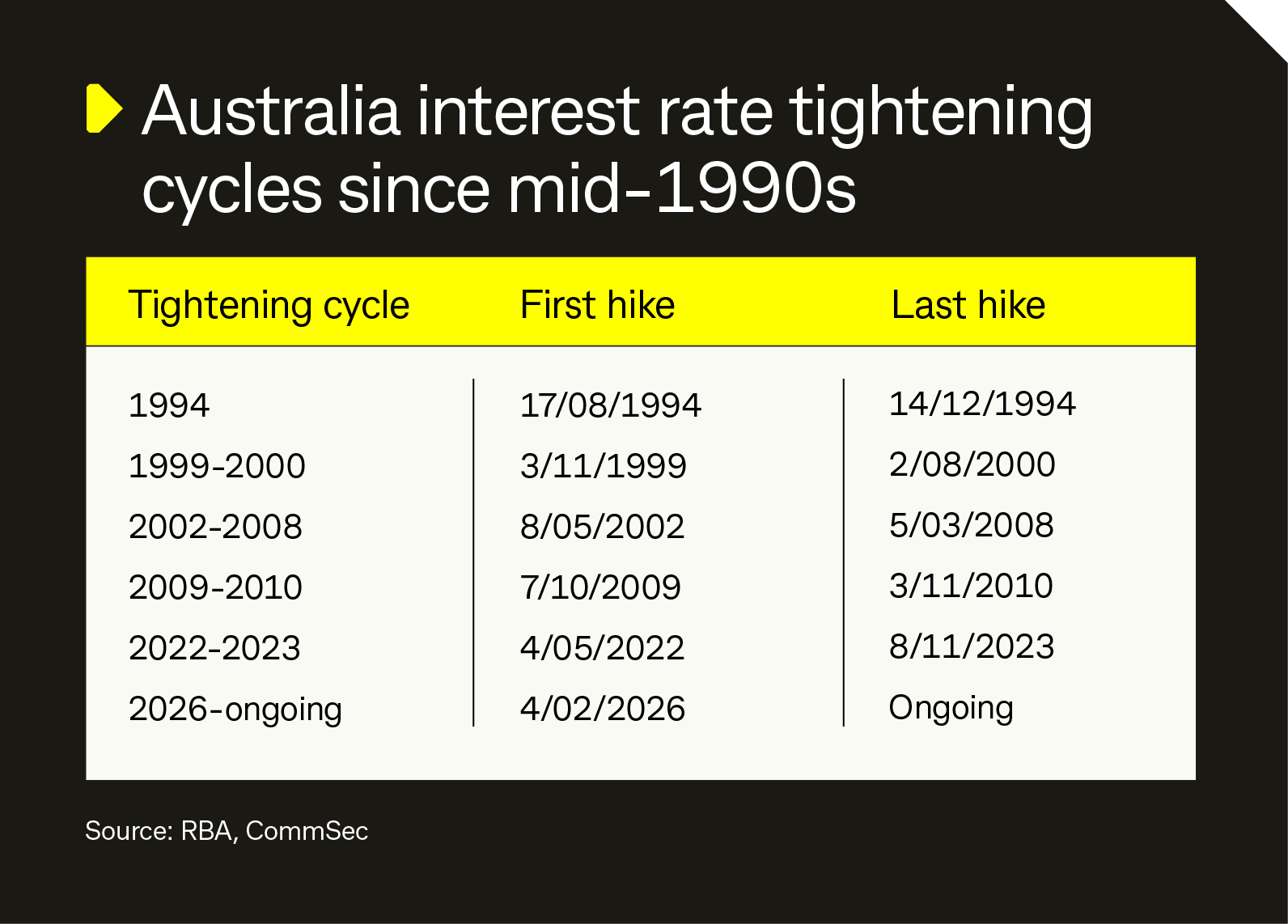
Note: A tightening cycle is defined as a sequence of RBA cash-rate increases beginning with the first increase following an easing or extended hold period and ending with the final increase before the next easing cycle.
The perception among investors is that a peak in interest rates is normally positive for stock markets, and that is generally right. Here are the returns for the ASX 200 after final hikes in a rate cycle.
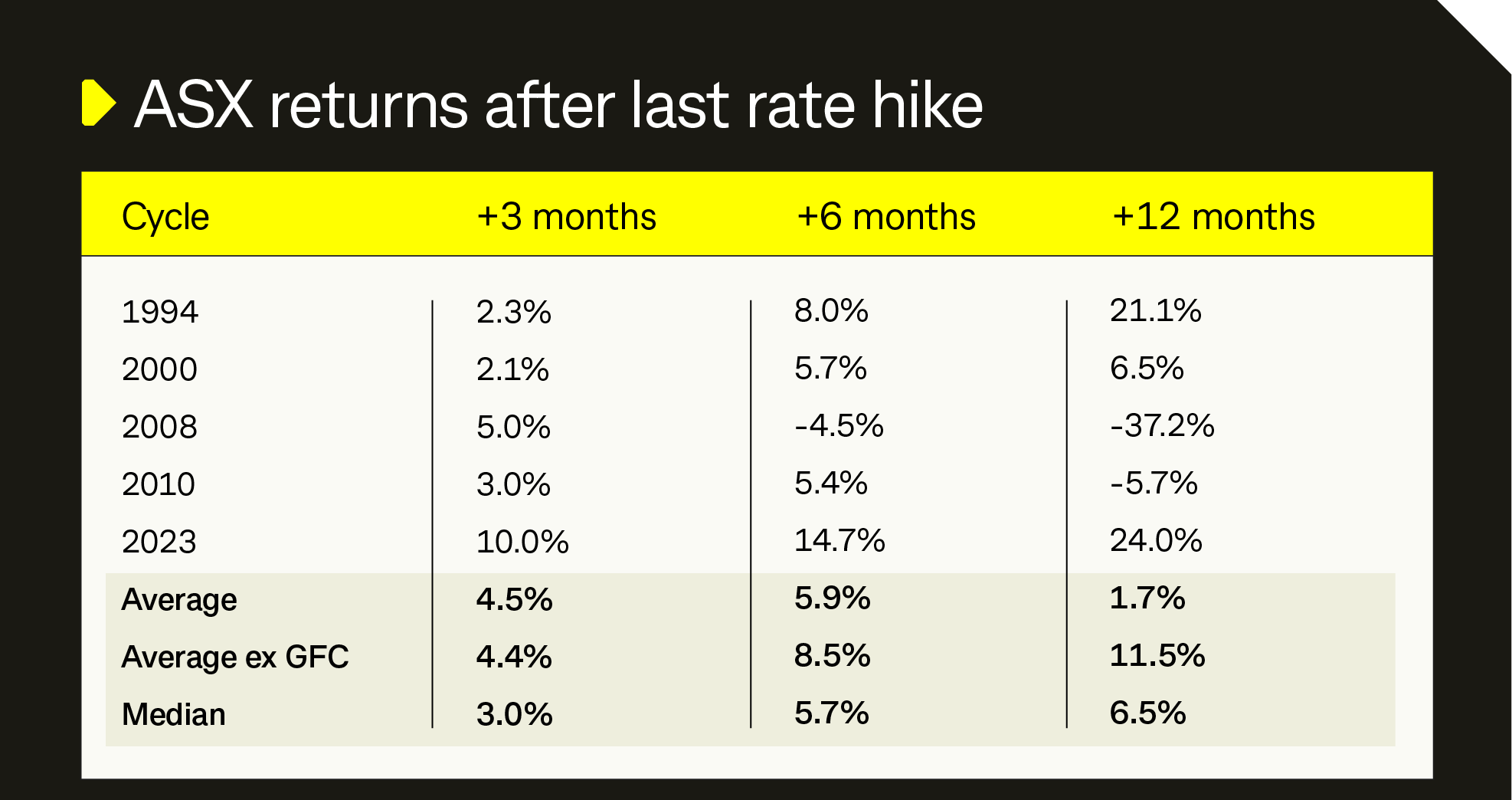
Note: ASX 200 returns include dividends. Source: Iress, CommSec
The obvious outlier is the global financial crisis (GFC) in 2008. The RBA raised rates twice in that year, with the final hike in March 2008. At the time, the ASX 200 peaked in November 2007 before plunging, particularly from October ’08.
Excluding the crisis, returns following final rate rises have been positive on average. Ex the GFC, the ASX 200 including dividends has climbed an average 11.5% in the 12 months after the last rate rise. That compares to a 9.5% annualised return since the mid-1990s.
The strongest returns happened where the economy held up well despite the rate increases – in 1994-1995 and 2023-2024.
The weakest returns were during periods of economic slowdown. GDP growth fell during 2008-2009 though Australia managed to avoid the recession that befell many developed countries at the time.
The 2010 period was unusual. The RBA made emergency cuts from 7.25% in August 2008 to 3.0% in April 2009. Once the downside risks from the crisis receded, it began reversing those emergency cuts and lifted rates to 4.75% by November 2010. Around this time, the European sovereign crisis emerged, and investors were cautious, which may explain part of the reason for poor returns following the final rate hike at that time.
Historically, returns from buying shares three or six months before the last rate hike have been mixed.
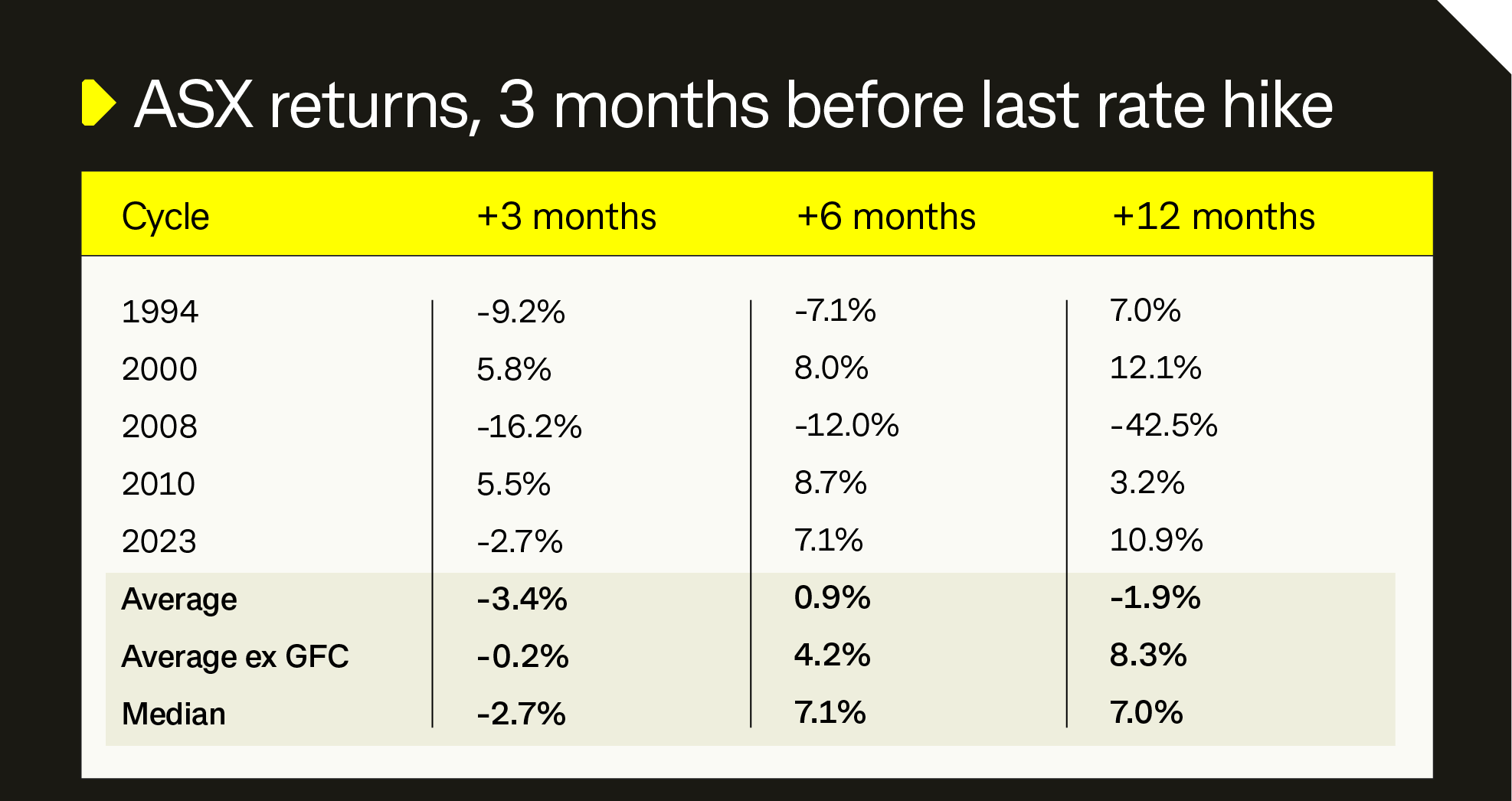
Note: ASX 200 returns include dividends. Source: Iress, CommSec
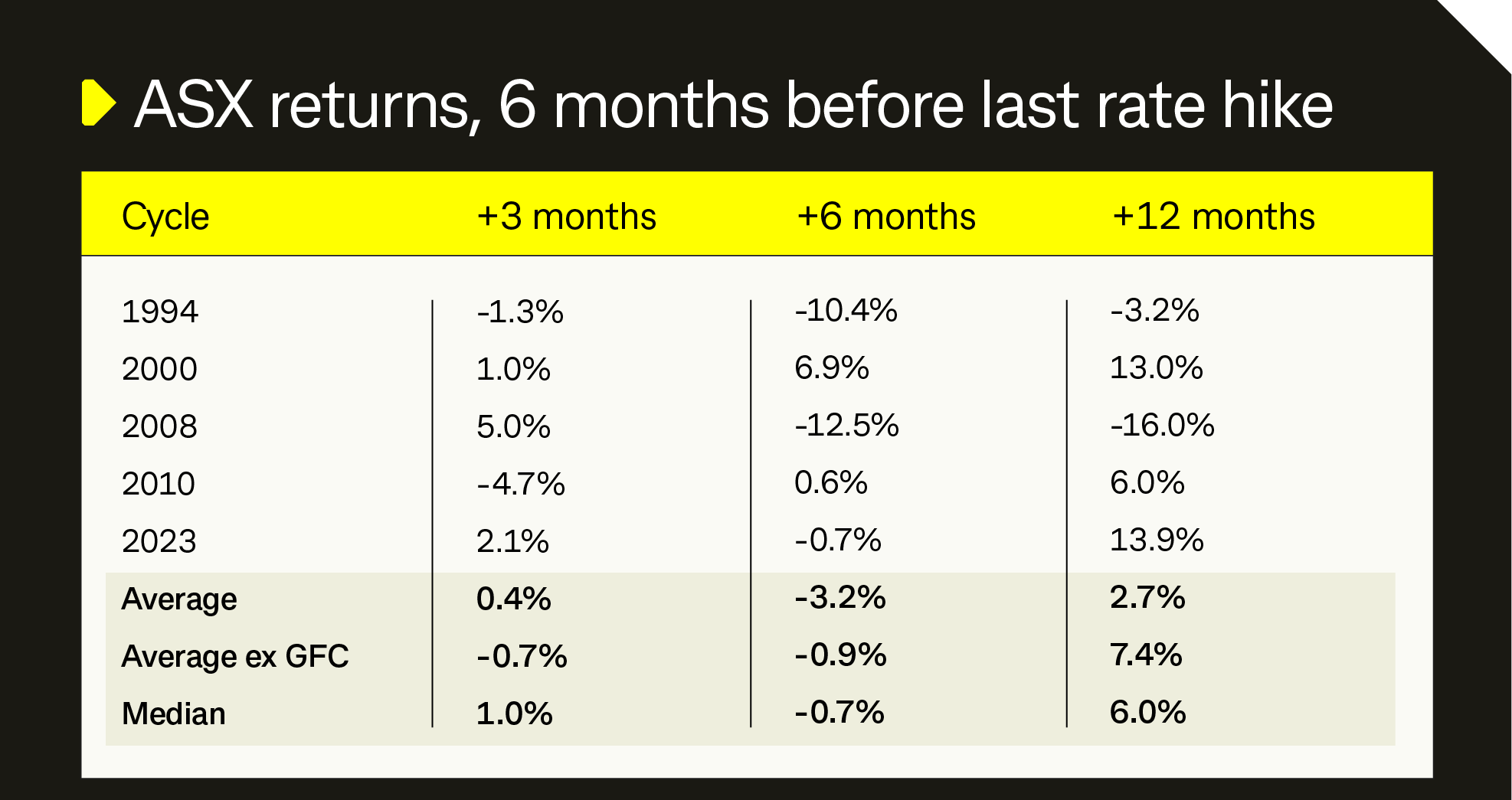
Note: ASX 200 returns include dividends. Source: Iress, CommSec
Sector winners and losers post last rate hike
Which sectors have historically performed best after interest rates have peaked?
Many investors would think that interest rate sensitive sectors such as real estate, consumer discretionary, and information technology would be among the biggest beneficiaries. But history shows differently.
Since 2000 (sector indexes were only introduced in 2000), financials, healthcare and industrials have outperformed other sectors following peaks in rates – up an average 20%, 17%, and 10% over 12 months respectively, excluding the GFC.
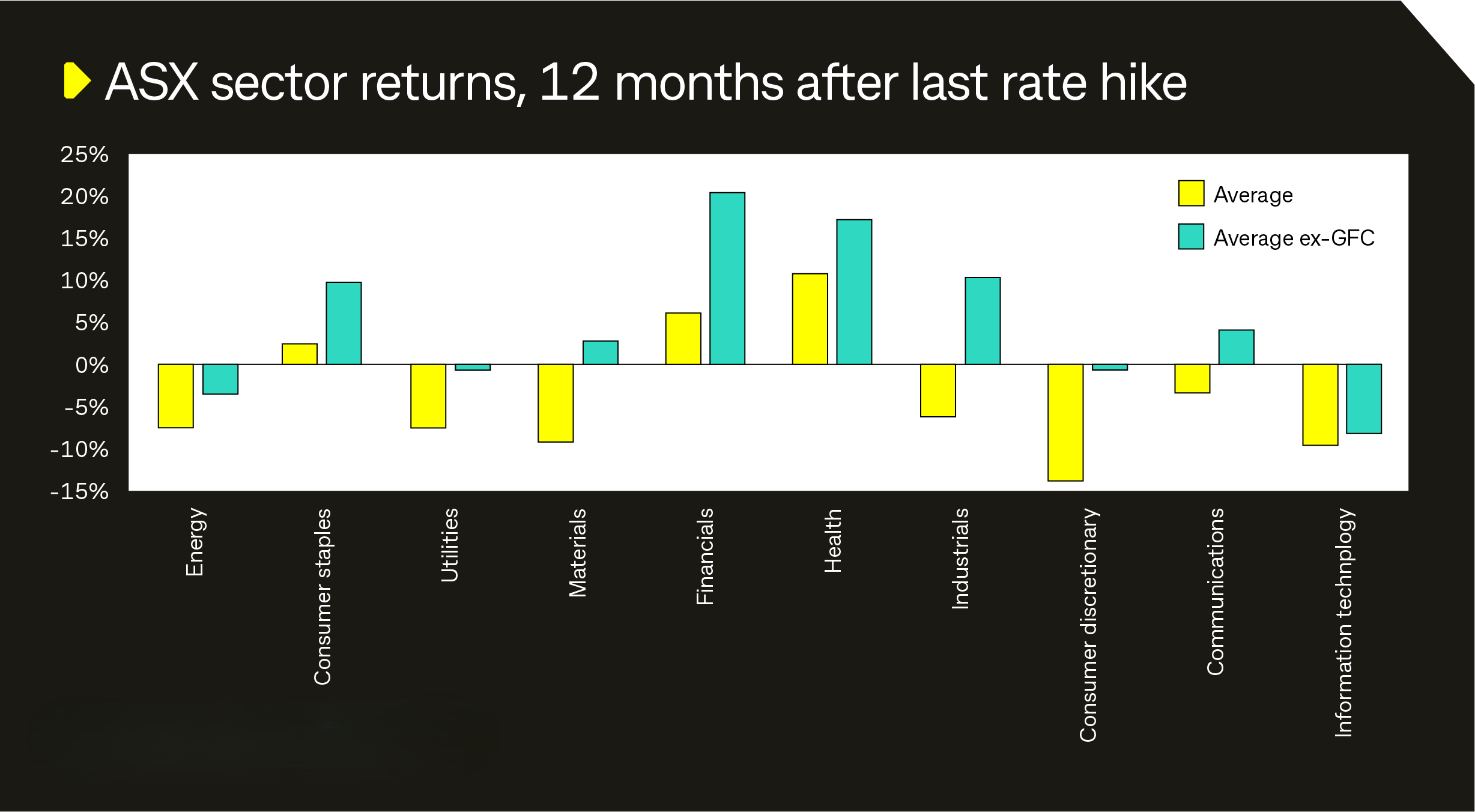
Note: ASX 200 returns include dividends. Source: Iress, CommSec
A-Reits are part of the financials sector, but they have underperformed the rest of the financials in each of the past instances when rates peaked. In 2008-2009, A-Reits fell heavily (-62%), they declined in 2010-2011 (-11%), they marginally lifted in 2000-2001 (+5%) and they were up strongly in 2023 (+23%).
Consumer discretionary has been another surprise underperformer. Most investors would think that a peak in rates would help mortgage burdens, along with disposable incomes and consumption. But the only period where consumer discretionary outperformed was in the most recent episode of peak rates in 2023-2024 (+27% over 12 months).
Meanwhile, technology is typically regarded as a beneficiary of falling rates as a large portion of their valuation comes from profits expected many years into the future, and higher rates and bond yields increase the discount rates applied to these profits. However, it has performed poorly in three of the four episodes following rate peaks since 2000. The one exception is 2023-2024, when the sector rocketed 59% higher over the 12 months.
How does it compare to periods when rates were hiked?
It is worth comparing periods when rates peaked to those when rates are first hiked.
Here is the performance of the ASX 200, including dividends, after a first rate hike.
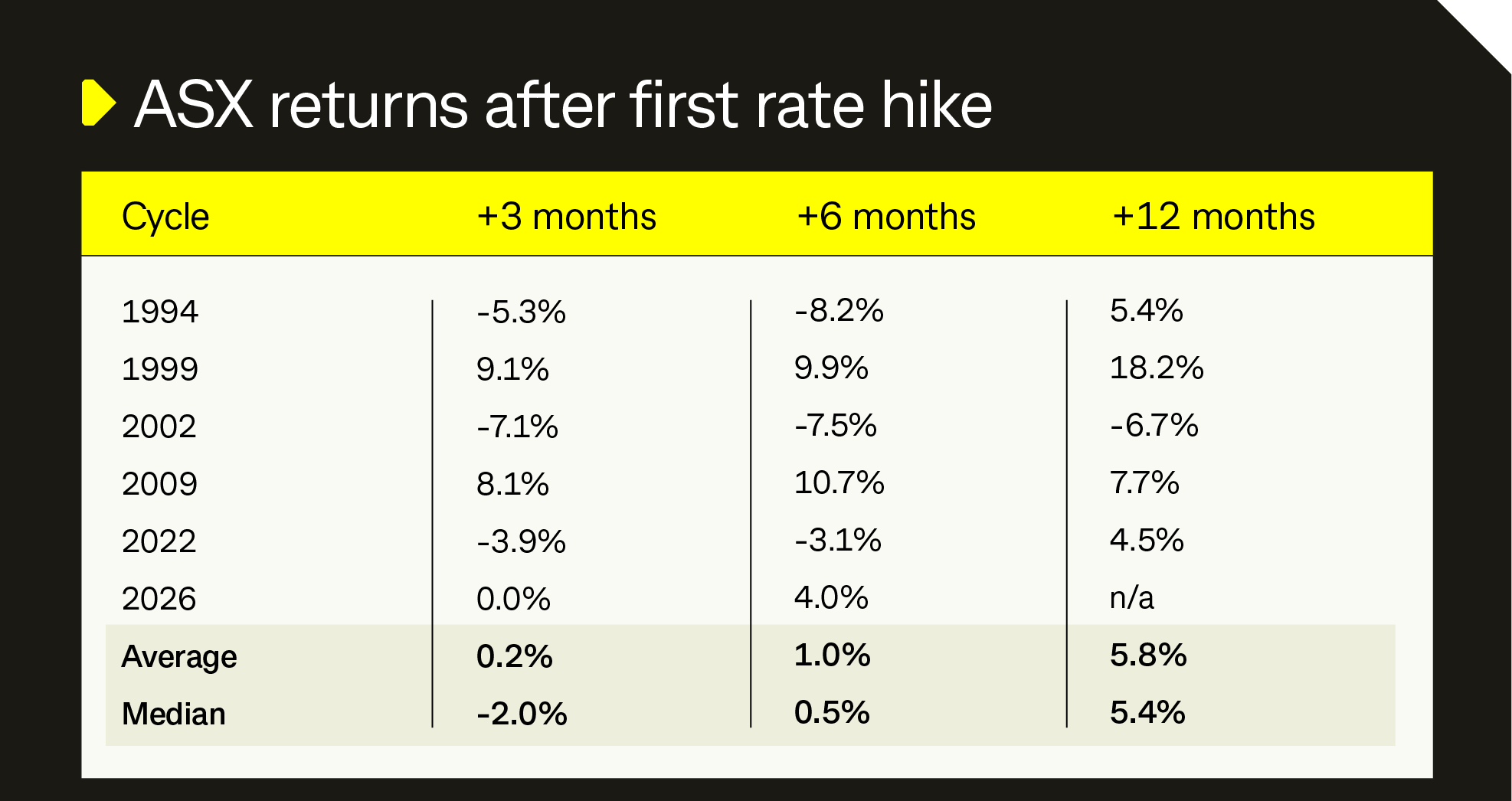
Note: ASX 200 returns include dividends. Source: Iress, CommSec
The table shows the ASX 200 has returned an average 5.8% in the 12 months after the RBA first increases interest rates. That compares to the 11.5% average return in the year after rates peak (ex the GFC). It also compares to the 9.5% annualised returns since 1994. Importantly, the RBA has historically rarely stopped at just one hike, typically raising rates several times once a tightening cycle begins.
Circumstances matter
History suggests that reaching the top of an interest-rate cycle can be supportive for Australian shares, but a peak in rates is no guarantee of strong returns. What happens to the economy, inflation and company earnings afterwards matters just as much.
The strongest post-peak returns have generally occurred when higher rates have brought inflation under control without causing a significant economic downturn. In that environment, investors can start looking ahead to lower interest rates while company earnings remain relatively resilient.
The experience of 2008 shows the other side of the equation. Although rates had peaked, deteriorating economic and financial conditions overwhelmed any benefit from the end of the tightening cycle. It is a reminder that rates can stop rising because inflation pressures are easing, or because economic conditions are worsening. The distinction matters for shares.
The post-pandemic cycle has added another complication. Inflation surged following COVID, subsequently eased and has more recently picked up again. The path of inflation from here will be important in determining whether the current level of interest rates proves to be the peak and, if so, how long rates remain there.
There are also forces beyond monetary policy that can dominate market returns. Starting valuations, company earnings, bond yields, commodity prices, global economic growth and geopolitical developments can all matter as much, or more than, the direction of the cash rate.
The historical numbers therefore suggest the final rate hike is one piece of the puzzle rather than a standalone signal. The more favourable combination has been a peak in rates accompanied by resilient economic growth and earnings. If the economy deteriorates materially after rates peak, history shows the outcome for shares can be very different.
 Back to


