


 CommSec
14 August 2026
Author: James Gruber is Equity Market Strategist at CommSec
Iron ore has helped make Australia wealthy this century. It rode the infrastructure and property boom in China during the 2000s and early 2010s and remains our dominant export.
But times are changing. As China’s economy continues to flounder, iron ore prices have struggled in recent years, and they have underperformed other major commodities this year.
By contrast, the price of copper has surged and has seemingly become everyone’s favourite commodity.
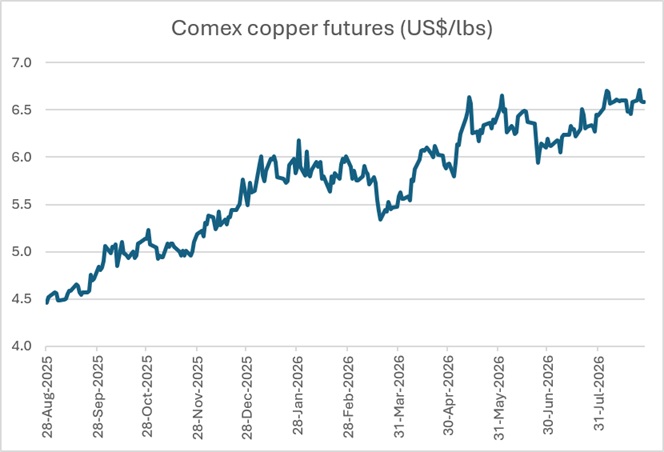
Source: CommSec
In a sign of the times, both BHP and Rio Tinto have switched the business models to become less dependent on iron ore in favour of copper. Today, copper accounts for a greater share of BHP’s earnings than iron ore.
It is reflected in recent share prices too, with BHP and Rio Tinto’s share prices both up more than 60% over the past 12 months. Australia’s largest pure play copper producer Sandfire Resources has also soared 84% over the same period.
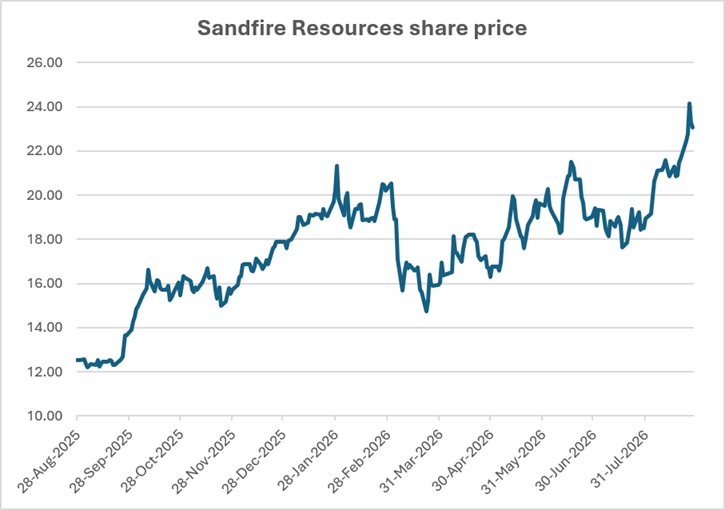
Source: CommSec
Conversely, pure-play iron ore companies have lagged. For instance, Fortescue has risen by just 1% over the past year.
This article will first go through why copper has become so popular, the supply and demand outlook for the metal in the short and long term, and the different ways to invest in copper on the ASX.
Why copper prices have skyrocketed this year
Copper markets are undoubtedly experiencing a significant supply crunch.
Recently, the spread between front-month London Metal Exchange (LME) copper prices and spot prices widened to its largest premium since 2021.
This indicates that traders are willing to pay more for copper available for immediate delivery than for metal delivered a month later - a sign that near-term physical supply is tight.
The squeeze is also evident in LME inventories, which have fallen for 42 consecutive days at the time of writing, marking the longest run of declines since 2014. Of the metal that remains in LME warehouses, nearly half is already scheduled for withdrawal.
Supply conditions appear even tighter outside the US, as producers redirect copper shipments to the American market ahead of the potential introduction of tariffs on refined copper.
The tight supply has been less a story about demand and more about disruptions to production. These disruptions have removed or deferred the equivalent of 3-3.5% of annual global mine production. The major incidents include:
The Grasberg mine in Indonesia: a mud rush through its massive underground mine in September last year is expected to result in 591 kilotonnes (kt) of lost copper in 2026. That copper alone is around 2.5% of annual world production.
The Kamoa-Kakula mine in Democratic Republic of Congo (DRC): Underground flooding in May 2025 is continuing to impact production, with estimates of around 220kt being lost this year.
Cobre Panama mine: continues to be offline, which has pulled about 300kt per year off production.
Chile storm issues: Extreme rain has forced a shutdown at major copper mines in Chile, including Los Pelambres, Candelaria, and El Teniente. It could result in at least 45kt of copper being lost to the market this year.
DRC copper-concentrate export ban: The government has banned exports of copper and cobalt concentrates to push domestic processing. The direct global impact should be relatively limited because most Congolese copper is already refined domestically, although some producers may be affected.
Removing at least 3% of annual production would put significant pressure on any commodity market, but the impact on copper has been particularly acute given supply was already tight.
What may happen in the short term
The largest swing factor for copper is supply from the Grasberg mine in Indonesia. Mine owner, Freeport McMoran, says operations should reach 80% of capacity by mid-2027 and approach full capacity by year-end 2027.
That is a long time to wait for a copper market with serious shortages. In the meantime, recycling is predicted to accelerate, mitigating at least some of the supply shortages.
On the demand side, the International Copper Study Group forecasts 2026 copper demand growth of 1.6%. That is less than most estimates at the start of the year, slowed by a weaker global economic outlook and trade disruption. That said, demand at these levels could be enough to sustain copper market deficits for the next six months, at least.
Once Grasberg and other mines get back to full capacity, the market should be much closer to in balance, and that may then be reflected in copper prices.
The long-term outlook
Some have declared copper is in a ‘structural bull market’ – that is, supply will not be able to keep up with demand over the next decade or more.
In our reading of history, though, there has yet to be a structural bull market in any commodity – there have been cycles, even long ones, but they have always led from boom to bust as supply eventually overwhelmed demand.
Will copper buck the trend?
Many analysts have turned incredibly optimistic on the metal. For instance, the International Energy Agency (IEA) forecasts that announced copper projects will leave supply about 25% below requirements in 2035. S&P Global expects exponential AI demand will result in a 25% copper shortfall by 2040.
There is merit to the optimism.
On the supply side, new mines take a long time to bring to production, usually 15-17 years.
Meanwhile, the quality of copper ore is declining. The IEA says average global copper grades have fallen about 40% since 1991. That matters because lower grades mean miners must move and process more rock to produce the same amount of copper.
Lastly, copper discoveries have slowed sharply. Only 5% of the copper deposits discovered over the past 35 years were discovered in the last decade, according to the IEA.
On the demand front, copper usage still comes predominantly from buildings, appliances and industrial equipment, but much of the incremental growth is coming from electrification, including:
- Electricity grids – copper is required throughout transmission and distribution networks, together with electric vehicles (EVs), charging, renewables, and storage.
- Renewables – solar and wind need substantial copper for cabling, transformers and grid connections.
- EVs – they require substantially more copper than conventional vehicles.
- Data centres/AI – used for grids, transformers, switchgear, server racks, and cooling.
- Urbanisation and infrastructure – especially in emerging markets.
S&P Global estimates that the AI/electrification theme will drive world demand from 28 Mt in 2025 to 42 Mt in 2040. It expects copper demand for data centres will more than double from 1.1 Mt to 2.5 Mt.
That all sounds like a lot of demand growth, but it is not in the scheme of things. Over the past 75 years, copper demand has grown by an average of 3.1% per annum – S&P’s forecast represents just 2.7% annualised growth.
The real issue will remain on the supply side. Higher copper prices will help with this issue as they will result in:
- Marginal mines becoming economic;
- Miners approving more expansions;
- Lower-grade deposits becoming viable;
- Exploration increasing;
- And recycling becoming more attractive.
On the last point, the ability of recycling to fill the supply gap seems underappreciated. Unlike some materials, copper can be recycled repeatedly without losing its useful properties. Of course, there are limits, as scrap availability depends on historical copper consumption and the lifetime of copper-containing assets.
The other thing to note is the role of technology. Higher copper prices incentivise potential technological advances. Technology may have a part to play on the demand side too, as it may allow us to consume less copper at some point in the future.
ASX-listed copper companies
For those wanting exposure to the copper theme, there are a variety of ways to do this.
Diversified heavyweight miners BHP and Rio Tinto offer significant global copper exposure.
Larger, pure-play copper companies include:
- Sandfire Resources (SFR)
- 29Metals (29M)
- Aeris Resources (AIS)
- AIC Miners (A1M)
Developers are another way to play the theme – they have copper projects not yet in production, – including:
- Develop Global (DVP)
- Hot Chili (HCH)
- Caravel Minerals (CVV)
- QMiners (QML)
 Back to

