


 CommSec
24 September 2026
Author: James Gruber is Equity Market Strategist at CommSec
The ASX 200 dividend yield is lower compared to its long run history, currently at 3.1%, but there are companies paying dividends above the market average.
Here are the ASX’s 10 highest-yielding companies:
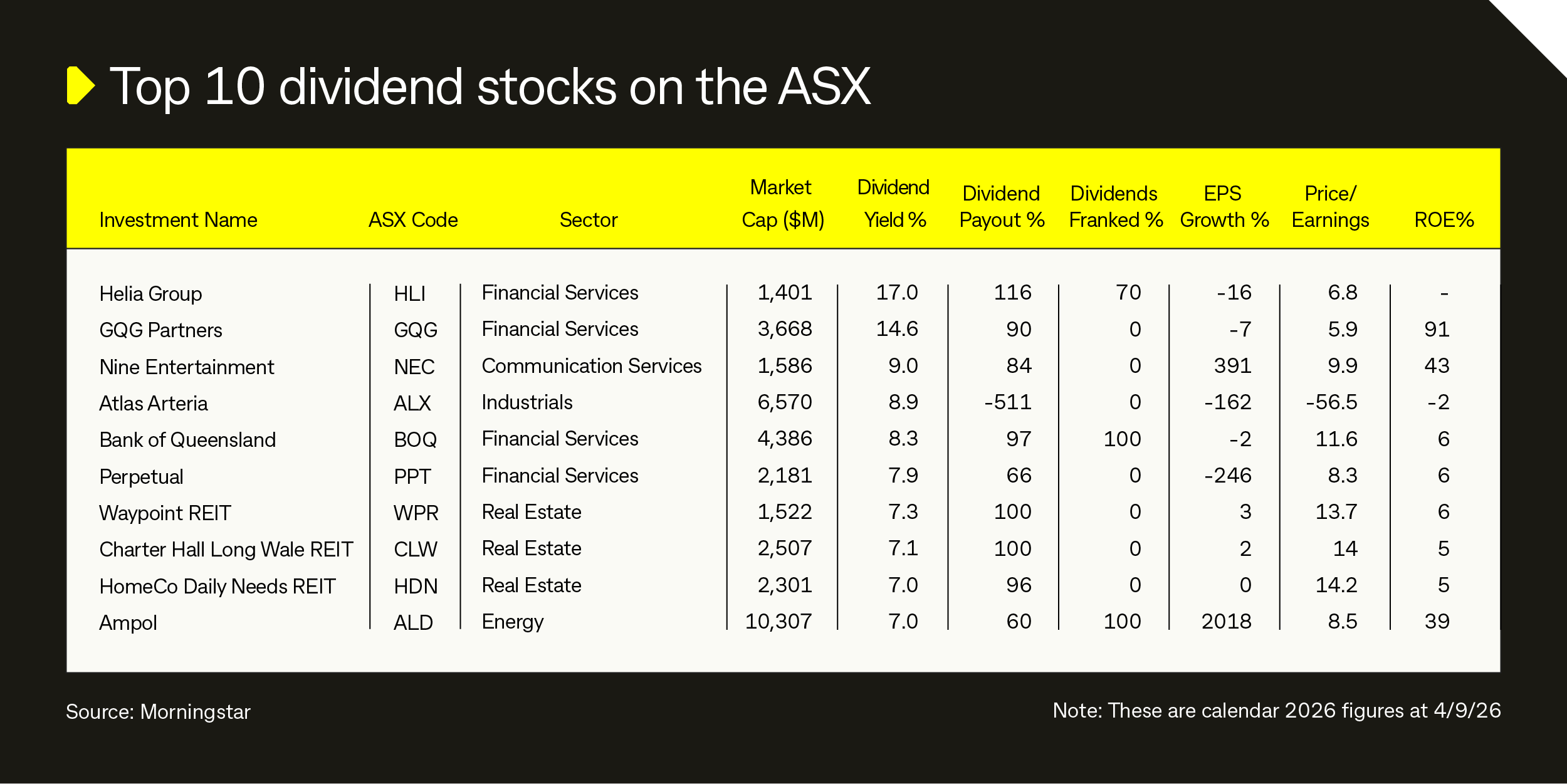
Several of these highest yielding companies are facing challenging outlooks.
Helia Group provides lenders mortgage insurance, which protects banks and other lenders against financial loss if a borrower defaults on a home loan. Risks in this sector have increased given the current downturn in the property market, the potential for additional rate hikes, and the possibility of higher credit loss provisions.
GQG is an international fund manager, and it has experienced fund outflows after a large underweight to global technology stocks impacted performance over the past year.
Similarly, Perpetual had years of fund outflows before recently receiving multiple takeover offers from a Swedish private equity firm, which it has rejected thus far.
Three commercial property REITs make the list. Parts of the commercial real estate sector have had a difficult few years post-Covid with the trend of people increasingly working from home, and with borrowing costs going up this year.
Ampol is at the other end of the spectrum as it has had a bumper year, with the volatility from Iran war pushing oil prices higher, making its refineries increasingly profitable. The company declared a final dividend of $1.85/share at its recent result, more than four times the previous year. There is a question as to whether that level of dividend is sustainable.
Now we will look at the highest dividend stocks among large cap companies – defined here as those greater than $10bn in market capitalisation:
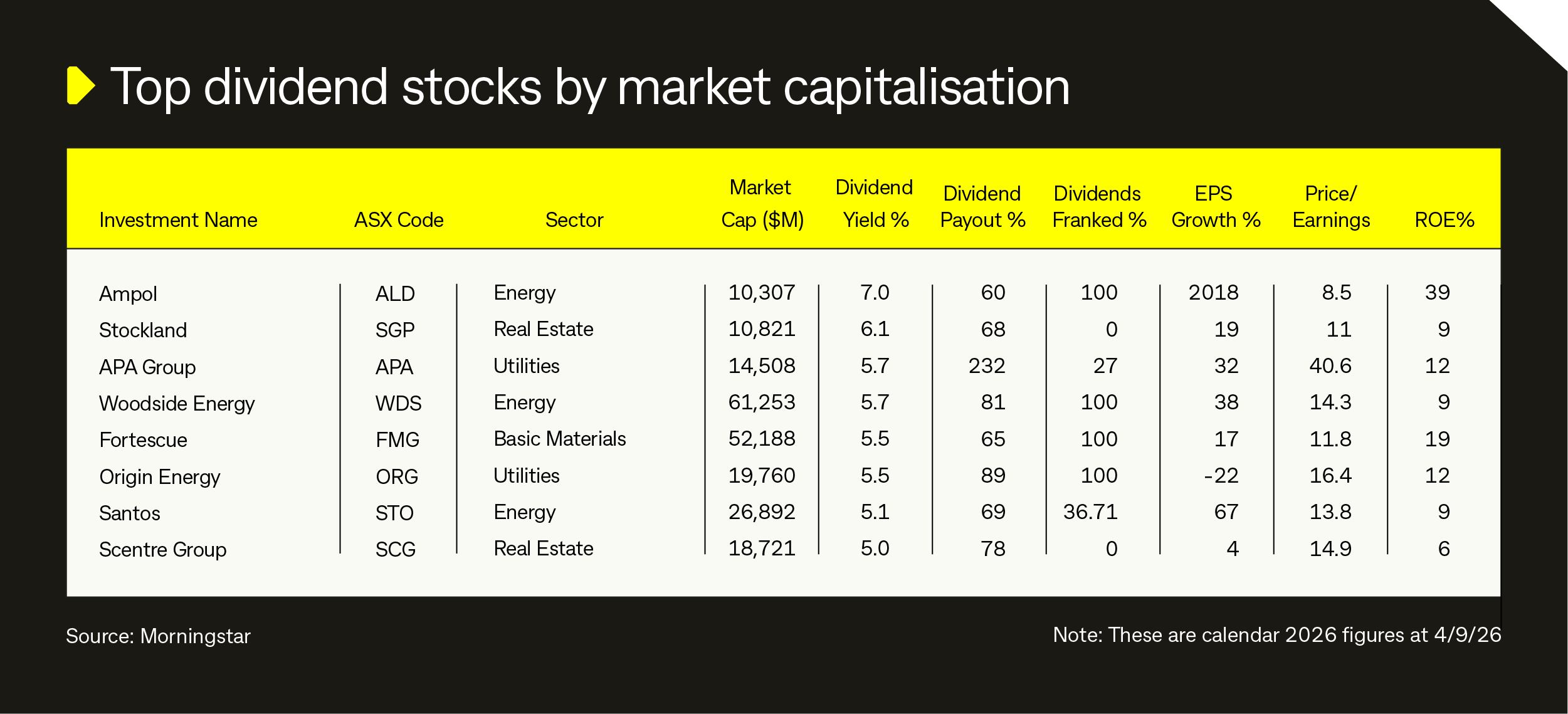
Energy and energy-related stocks dominate, with Woodside Energy, Origin Energy, Ampol, and Santos included.
There are also utilities such as APA Group.
Mall owner, Scentre Group, makes the list as its business remained resilient even with the growing share of online shopping. Recently, the company’s chief executive, Elliot Rusanov, told the Australian Financial Review property summit that there were just 100 vacancies across the entirety of Westfield’s 42 malls.
Finally, here is a table of the highest dividend yielding stocks that operate in what may be considered more defensive sectors.
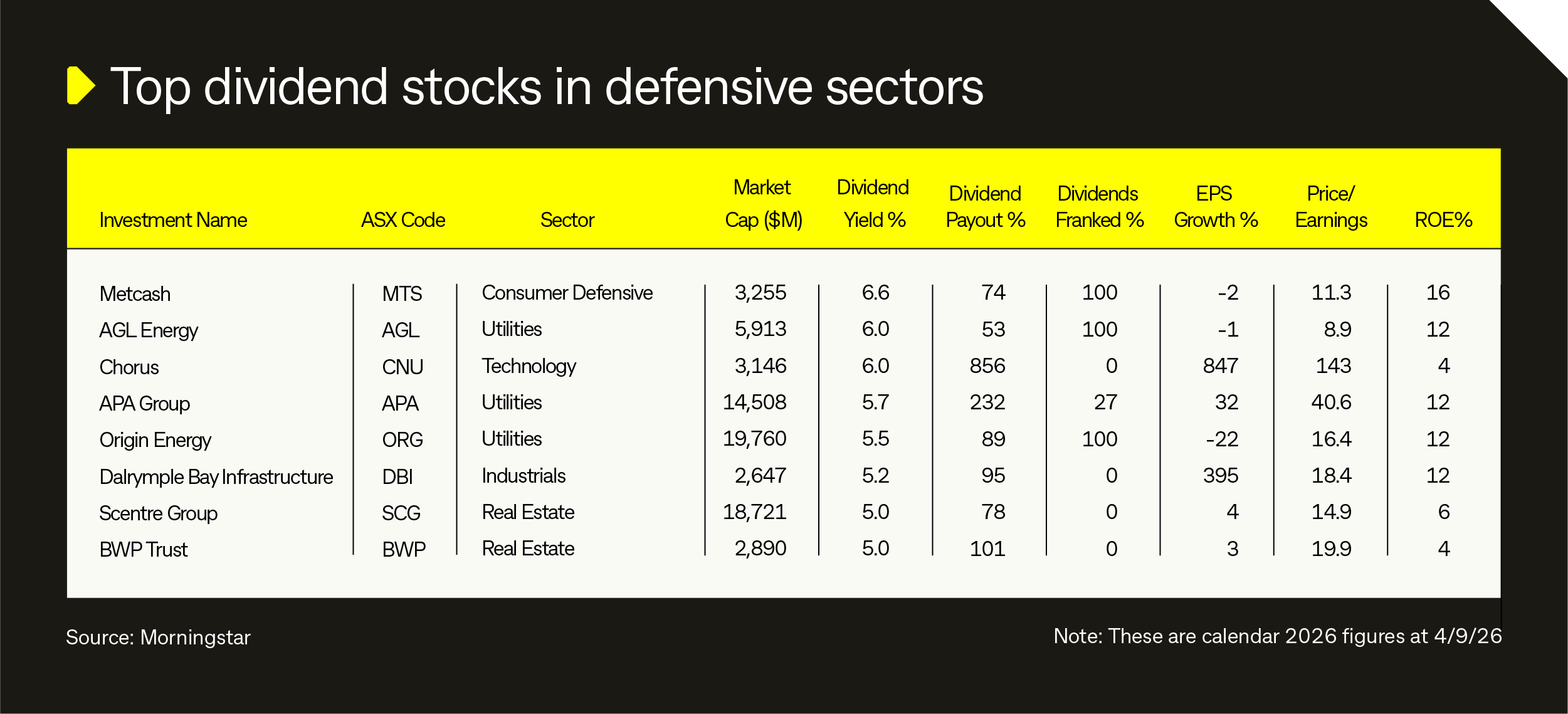
As a supermarket operator, Metcash may be considered a defensive stock offering an above-market -average, full-franked dividend yield.
Similarly, utilities are generally considered defensive, and APA Group, Origin Energy, and AGL Energy fit in that category.
Telecommunications are traditionally seen as a relatively defensive sector, and Chorus, as New Zealand’s fixed line communications infrastructure business, is in that space.
BWP Trust is a unique listed REIT. It owns a $3.7bn portfolio, and about 80% of its rent roll is from Bunnings, a major Australian retailer. It also has lower debt levels than most REITs.
Important caveats
There are a few important considerations for investors looking at dividend stocks, including that a company’s past dividend yield may not be sustained in the future. As outlined below, dividends can change because of factors such as earnings, one-off events and payout ratios.
Dividends come from earnings, and if earnings are abnormally high, dividends could be excessively high too. This can happen if a company earns extraordinary profits from a one-off event. It can also occur in highly cyclical sectors such as commodities where high commodity prices can bring bumper profits, though that can reverse if prices slump. For instance, even mining heavyweights, BHP and Rio Tinto, have delivered volatile earnings and dividends per share over the past decade.
Another thing to note is the dividend payout ratio of companies. If the dividend payout ratio is close to 100%, it may indicate that a business may be dependent on rising earnings to sustain the yield (there are other methods if earnings do not cover the dividends, such as using cash reserves or increasing debt to maintain the dividend).
Finally, consider potential tax implications when it comes to dividend stocks. Some of the above stocks offer 100% franking on dividends, though many do not. Much will depend on your personal circumstances, so consult a financial adviser if needed.
 Back to

