
CommSec Pulse: Baby Boomers
This report dives into the trading practices and preferences of Baby Boomers, a small cohort with a big slice of the wealth pie.

Who are the Baby Boomers?
The answer to this question is likely to vary significantly, according to who you ask. A Baby Boomer themselves, typically born between ~1946 (the first full year after the end of WW2) and 1964, might tell you they’re the generation that worked and saved hard to provide a home and financial stability for their family. One of their Gen X or Millennial children or grandchildren, on the other hand, may point to the hyper-expensive property market, global geopolitical instability and climate change challenges they feel they’ve unwillingly inherited.
Of course, it’s possible for two things to both be true. What’s clear from our research is that, of the four generational cohorts we’ve examined, Baby Boomers present notably higher levels of wealth than the younger generations.
All the facts and figures cited below are taken from CommSec’s insights into and analysis of more than two million customers.
How Baby Boomers are managing their finances
As a rule, Baby Boomers value financial security and stability, shaped by decades of post-war economic growth, market fluctuations and evolving retirement systems. Many have accumulated significant assets over their working lives and are now focused on preserving their wealth, generating reliable income and maintaining their lifestyle in retirement. Some may also be supporting adult children and/or managing healthcare, while also making their own aged care considerations.
Financial wellbeing for Baby Boomers is increasingly centred on protecting their relatively strong financial position and ensuring long-term confidence. Key priorities include:
- Preserving savings and investments
- Generating retirement income
- Managing healthcare and aged care costs
- Planning for estate and legacy needs
- Maintaining financial independence
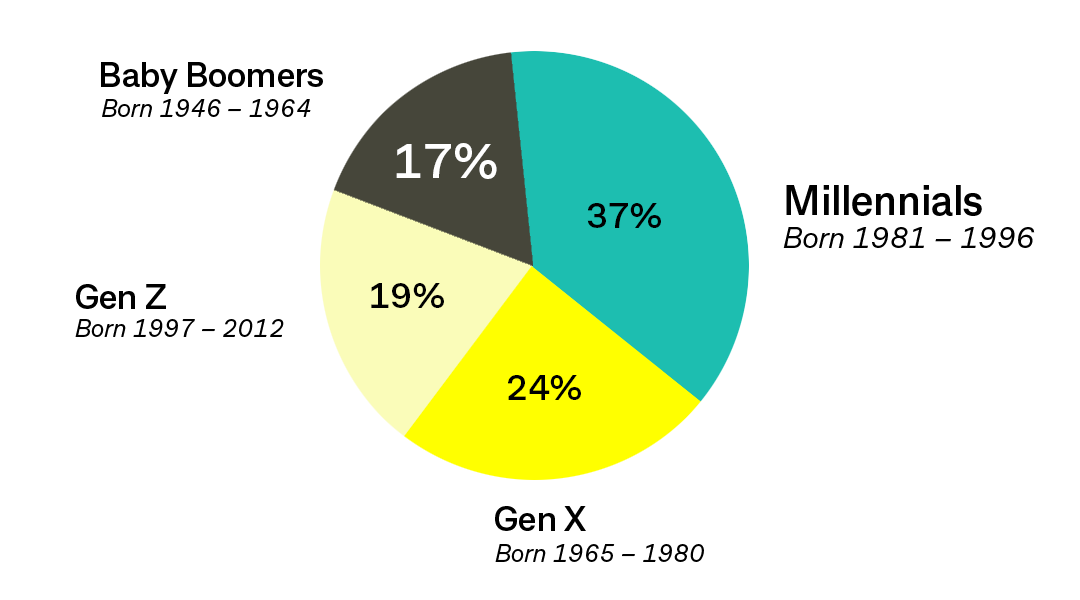
Baby Boomers are CommSec’s smallest trading generation
CommSec’s trading data shows that 17% of all our active investors are Baby Boomers, the smallest of the generational cohorts (excluding the Greatest and Silent generations, both born pre-1946). Yet they hold around 46% ($128.6bn) of all total wealth, more than the total holdings of Gen X (~27%) and Millennials (~12%) combined.

Portfolio value & stock holdings
Baby Boomers hold an average of around $541,000 in portfolio size – a staggering 27+ times the average balance of a Gen Z trader (around $20k) – and have an average of eight stock holdings.

Diversification: ETF, Australian or International?
Baby Boomers overwhelmingly (95%) stick with the ASX and value traditional blue-chip local stocks like BHP, CBA and CSL. Only 5% of Baby Boomers have exposure to international markets, half that of Gen X, Millennials and Gen Z, while fewer than 1 in 5 Baby Boomers are trading in ETFs compared with more than half of all Millennials and more than two-thirds of all Gen Zers.
Baby Boomers are experienced, disciplined & focused on wealth preservation
Baby Boomers are more likely than the younger generations to rely on traditional investment vehicles, retirement accounts and professional financial advice. Many have built substantial wealth over decades and invest with a strong focus on stability and income.
Now in or nearing retirement, Baby Boomers prioritise capital preservation, reliable income streams and maintaining their lifestyle. They typically diversify across shares, property, managed funds, fixed income and cash investments.
Having experienced multiple economic and market cycles, Baby Boomers generally favour a measured approach to investing, balancing growth opportunities with risk management and long-term financial security.
|
|
Baby Boomers |
Gen X |
|
Main platforms |
Traditional brokers, retirement accounts, financial advisers |
Traditional brokers, retirement accounts |
|
Risk appetite |
More conservative and focused on capital preservation |
More balanced and defensive |
|
Popular investments |
Dividend-paying shares, fixed income, property, balanced funds |
Blue-chip shares, dividends, index funds |
|
Investment style |
Wealth preservation and income-focused |
Experience-driven and pragmatic |
|
Information sources |
Financial advisers, mainstream finance media, research reports |
Advisers, finance media, research |
|
Trading frequency |
Less frequent, long-term investors |
More patient/long-term |
How Baby Boomers traded in 2026
On the ASX, the top traded names for Baby Boomers were all individual shares. In US markets, the list included company shares alongside exchange-traded products. In ETFs, the rankings spanned Australian, US and international markets.

Top traded Aussie shares for Baby Boomers
The Baby Boomer ASX top five for FY26 include blue-chip resource/materials stocks BHP, Woodside and Pilbara.
|
Stock code |
Company name |
Top traded US securities by Baby Boomers
As with Millennials and Gen Z, the US top five stock list for Baby Boomers is dominated by big Nasdaq names like Tesla and NVIDIA.
|
Stock code |
Company name |
Top traded ETFs/ETPs by Baby Boomers
The Baby Boomer ETF/ETP top five includes funds tied to the Nasdaq-100, Australian shares, the S&P 500, and international shares.
The bottom line
Baby Boomers are experienced investors with a strong focus on preserving their wealth and generating reliable income in retirement. Having lived through several more economic and market cycles than their younger cohorts, they typically take a measured approach to managing their finances.
While many Aussie Baby Boomer investors are diversifying internationally, investing in global equities through major exchanges such as the Nasdaq, most continue to favour Australian-listed companies to support their long-term financial security and portfolio diversification.
To learn more about how to invest in global companies, see International Trading.


Across the generations
CommSec’s analysis of our customers’ profiles and activities across FY26 has uncovered some fascinating insights into Aussie traders and trading behaviour broadly, regardless of their generation. Among our key findings:
More Australians are investing, both domestically and especially internationally We saw growth of 11.5% in trading customers over the past fiscal year, with trading up 27% on FY25 and traded value up 33%. New domestic stock accounts were up 10% and new international accounts up 16%
Aussie traders are more engaged overall The proportion of our customers who completed a trade in the 12 months to May ticked up by 0.2% compared to the same timeframe to November 2025. We also saw more people trade within the first 90 days of opening their trading account
Women are a bigger force in the trading market than ever before Female investors are driving a bigger share of new money into markets, at 42% of first-time investors in FY26, up from 36.3% two years ago. They now represent 34% of our active investors, up slightly from FY25, and they tend to trade more in ETFs than their male counterparts, who generally trade more in direct equities
Investors are getting younger, especially first-time investors Traded value for our under-40 customers increased 54.9%, compared with 30.3% for customers aged 40+. The under‑40 share of first‑time investor activity climbed from 63.2% in FY24 to 66.2% in FY26
See the bigger picture of how all generations are investing

Explore the market and invest with confidence
Get more investment ideas with the CommSec app using its latest features including price alerts, AI driven stock reports, new international trading and watchlist, and more!
Download the latest version of the app to see the latest market price data for ASX, ETF and international shares.
|
|