
CommSec Pulse: Millennials
With insights drawn from the trading activity of more than two million CommSec investors, this report shows how Millennials are trading and what matters to them.

Who are the Millennials?
Typically born between ~1981 and 1996, Millennials came of age during a turbulent economic period – think the 2008 Global Financial Crisis, rising housing costs and rapid technological change. Those factors shaped how they think about money in ways that differ from earlier and subsequent generations.
All the facts and figures cited below are taken from CommSec’s insights into and analysis of more than two million customers, and are current as of 30 June 2026.
How Millennials are managing their finances
Many Millennials prioritise financial stability, but they’ve had a harder path getting there. Compared to Gen X or Baby Boomers at the same age, they often carry:
- Higher student debt
- Slower wage growth early in their careers
- Higher cost of living (especially housing in cities)
Because of this, financial wellbeing for millennials appears to have shifted from traditional milestones, such as owning a home early, to flexibility and security, with emergency savings, manageable debt, income stability and investing top of mind.
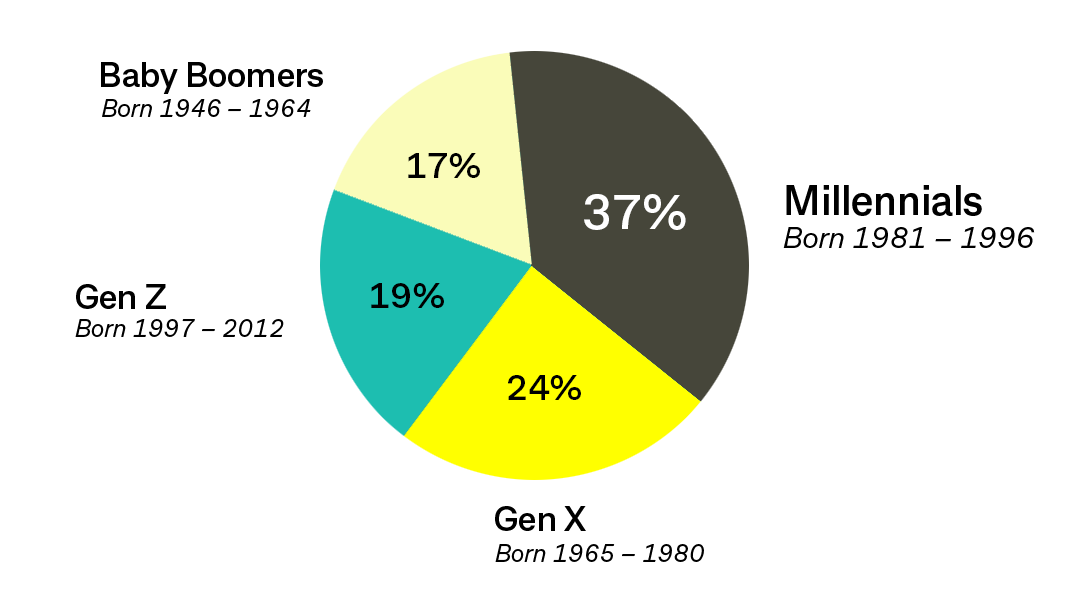
Millennials are CommSec’s largest trading generation
CommSec’s trading data shows that 37% of all our investors are Millennials.

Portfolio value & stock holdings
Millennials hold an average of around $66,000 in portfolio size and have an average of four stock holdings.

Diversification: ETF, Australian or International?
Millennials invest in exchange traded funds (ETF) twice as much as Baby Boomers and they trade in international stocks by +60%.
Millennials are tech savvy, active & reactive
Millennials helped normalise app-based investing, commission-free trading platforms and fractional shares, while ETFs made investing accessible with small amounts of money. Many Millennials learned investing online in place of conventional mode channels like financial advisors. Reddit communities and fin-fluencers have also strongly influenced investment behaviour.
By contrast, Gen X still tends to rely more on traditional brokerage accounts, retirement funds and professional advice. However, they currently appear to trade with higher conviction. Charles Schwab’s recent trading data showed Gen X maintaining some of the strongest equity market sentiment among all generations in early 2026.
|
|
Millennials |
Gen X |
|
Main platforms |
Mobile apps, digital platforms, robo-advisors |
Traditional brokers, retirement accounts |
|
Risk appetite |
Higher growth focus |
More balanced and defensive |
|
Popular investments |
Tech stocks, AI, ETFs, crypto exposure |
Blue-chip shares, dividends, index funds |
|
Investment style |
DIY and tech-driven |
Experience-driven and pragmatic |
|
Information sources |
Social media, YouTube, Reddit |
Advisors, finance media, research |
|
Trading frequency |
More active |
More patient/long-term |
How Millennials traded in 2026
The Millennial rankings looked different across each category. On the ASX, the top traded names are all individual shares. In US markets, the list included company shares alongside exchange-traded products. In ETFs, the rankings spanned Australian, US and international markets.

Top traded Aussie shares by Millennials
The Millennial ASX top five for FY26 include Pilbara Minerals, Zip and DroneShield. Compared with the other category lists, the local ranking was made up entirely of individual ASX shares.
|
Stock Code |
Company Name |
Top traded US securities by Millennials
The Millennial US top five include big Nasdaq names Tesla, NVIDIA and SpaceX.
|
Stock Code |
Company Name |
Top traded ETFs by Millennials
The Millennial ETF top five includes funds tied to the Nasdaq-100, Australian shares, the S&P 500, international shares and the Global 100. Compared with the ASX and US rankings, the ETF list covered the widest spread of markets.
The bottom line
Millennials are financially aware and tech savvy but constrained by structural challenges. Their approach to money is pragmatic: balance responsibility (saving, investing, debt management) while living in the present (experiences and convenience).
The majority of Australian millennials are still trading Australian owned companies but there’s a growing number of investors also exploring international companies listed in the New York Stock Exchange (NYSE) and Nasdaq.
To learn more about how to invest in global companies, see International Trading.


Across the generations
CommSec’s analysis of our customers’ profiles and activities across FY26 has uncovered some fascinating insights into Aussie traders and trading behaviour broadly, regardless of their generation. Among our key findings:
More Australians are investing, both domestically and especially internationally We saw growth of 11.5% in trading customers over the past fiscal year, with trading up 27% on FY25 and traded value up 33%. New domestic stock accounts were up 10% and new international accounts up 16%
Aussie traders are more engaged overall The proportion of our customers who completed a trade in the 12 months to May ticked up by 0.2% compared to the same timeframe to November 2025. We also saw more people trade within the first 90 days of opening their trading account
Women are a bigger force in the trading market than ever before Female investors are driving a bigger share of new money into markets, at 42% of first-time investors in FY26, up from 36.3% two years ago. They now represent 34% of our active investors, up slightly from FY25, and they tend to trade more in ETFs than their male counterparts, who generally trade more in direct equities
Investors are getting younger, especially first-time investors Traded value for our under-40 customers increased 54.9%, compared with 30.3% for customers aged 40+. The under‑40 share of first‑time investor activity climbed from 63.2% in FY24 to 66.2% in FY26
See the bigger picture of how all generations are investing



Explore the market and invest with confidence
Get more investment ideas with the CommSec app using its latest features including price alerts, AI driven stock reports, new international trading and watchlist, and more!
Download the latest version of the app to see the latest market price data for ASX, ETF and international shares.
|
|